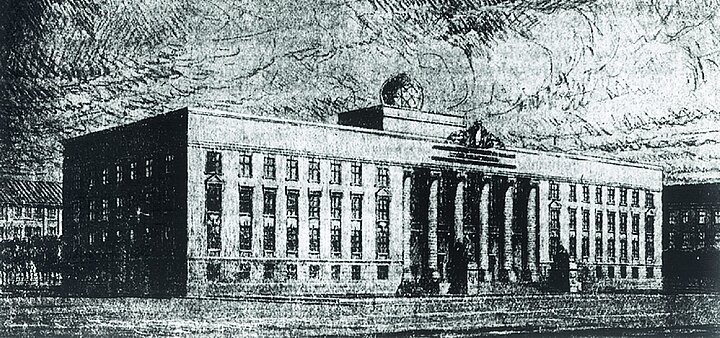
The origins of the Faculty date back to 1919, when three departments were established within the only faculty of the then Mining Academy - the Faculty of Mining: the Department of Mineralogy and Petrography, the Department of Geology and the Department of Applied Geology. After the Second World War, they became part of the Faculty of Geology and Surveying, established in 1946, from which the Faculty of Geology was later formed in 1951/52, followed by the Faculty of Geology and Prospecting in 1952/53. In the following years, the Faculty developed dynamically and its structure evolved. Since the academic year 1992/93, it has operated as the Faculty of Geology, Geophysics and Environmental Protection.
As the only faculty in Poland of its kind, it educates engineers in geology and applied geophysics while also offering courses typical of a classical university. The education received by graduates enables them to pursue employment in industrial plants, research institutions, schools, tourist offices, and state and local government administration.
The research conducted at the Faculty of Geology, Geophysics and Environmental Protection is primarily applied in nature. One of the largest groups of professors and habilitated doctors in Earth sciences among European universities, supported by a numerous body of doctors and MSc graduates, together with well-equipped laboratories, makes it possible to undertake almost any research topic. The Faculty also conducts basic research, i.e. research that helps us better understand the world around us and the processes occurring within it, even if its results do not yet have practical applications due to the current state of knowledge and technology. Among the Faculty staff are former scholarship holders of leading scientific foundations: the American Fulbright Foundation and the German Humboldt Foundation.
From the very beginning of AGH University, the foundations of what is now the Faculty of Geology, Geophysics and Environmental Protection were represented by three departments operating within the University’s only faculty at that time — the Faculty of Mining. These were the Department of Geology, the Department of Mineralogy and Petrography, and the Department of Applied Geology.
In 1946, following the Second World War, these departments became part of the newly established Faculty of Geology and Surveying. In 1951, the Faculty was divided into two separate faculties: the Faculty of Mining Surveying and the Faculty of Geology and Exploration. The three departments subsequently became part of the latter.
In 1967, several departments were separated from the Faculty and, together with part of the Faculty of Mining, formed the Faculty of Drilling and Petroleum Engineering, now known as the Faculty of Drilling, Oil and Gas. Until 1968, the department remained the basic organisational unit of the Faculty, as was also the case throughout the University.
As a result of an organisational reform carried out in 1968, the departments were replaced by institutes. This organisational structure remained in place until the end of 1992, when the four institutes listed below were reorganised into ten departments and divisions:
Over the following years, three of these units were further divided, resulting in a Faculty structure comprising fourteen departments and divisions.
At the turn of the 1960s and 1970s, and during the first half of the 1970s, the system of financing the institutes enabled a substantial increase in the number of academic staff. The Geological Museum was also established in the 1970s. Its exhibition, displayed in the corridors of the main AGH building, continues to be expanded to this day.
In 1992, the Faculty changed its name and has since operated as the Faculty of Geology, Geophysics and Environmental Protection.
Wydział Geologii, Geofizyki i Ochrony Środowiska
Akademia Górniczo-Hutnicza
im. Stanisława Staszica
al. Mickiewicza 30
30-059 Kraków
NIP AGH: 675 000 19 23
Dziekanat
tel. +48.12.617.23.50–51
e-mail: dziekanatwggios@agh.edu.pl
Biuro Dziekana
tel. +48.12.617.32.54

